Discourse Community: A Tool for Advanced Audience Analysis
Discourse community theory is a valuable analytical tool that can help you analyze unfamiliar groups, understand familiar groups on a deeper level, and unpack conflict and miscommunication.
Communication Basics
The sender-receiver model for interpersonal communication illustrates how messages move between communicators. Communication partners create messages and then interpret them.
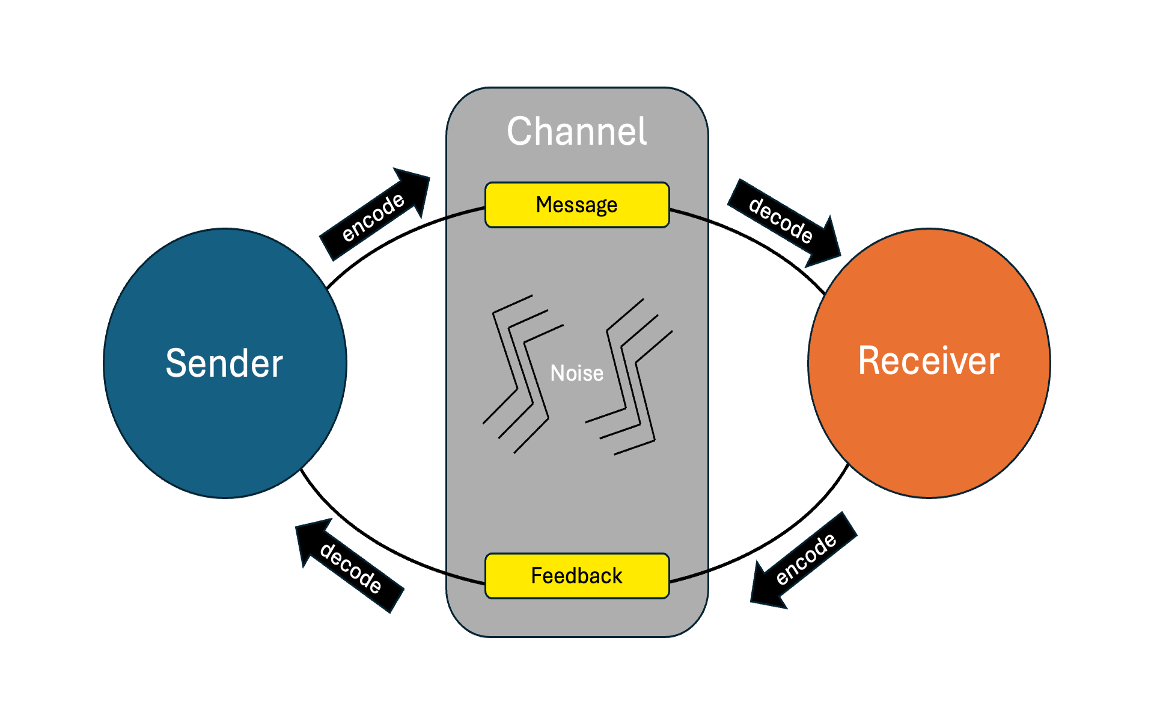
Image adapted from Wikimedia Commons

This image only illustrates the relationship in part, however, because it’s static. In communication, the sender and receiver switch roles, change channels, and even send and receive messages simultaneously. You might be speaking to a coworker while observing their facial expressions and bodily movements and receiving the message that you are boring them.
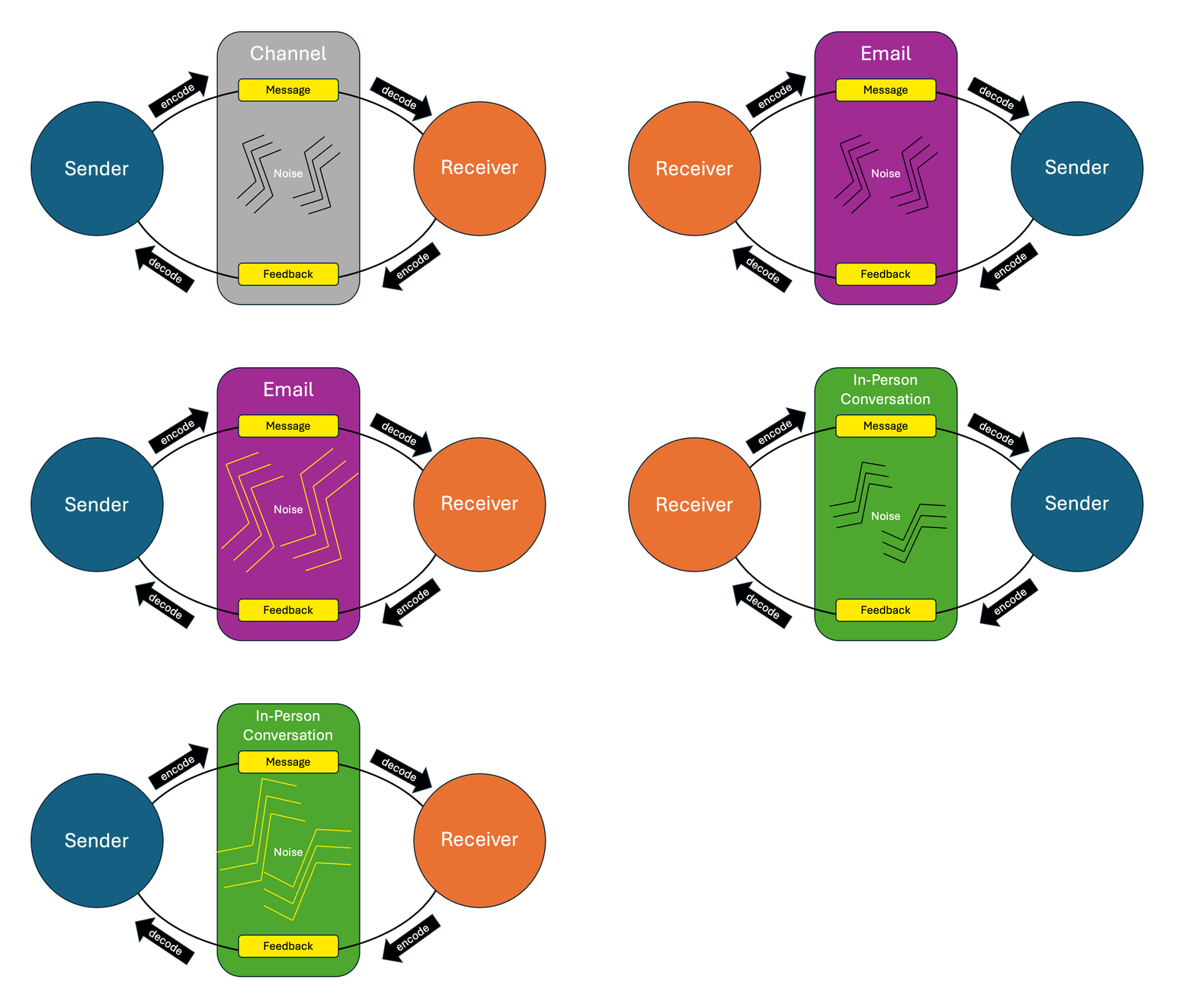
Noise, or things that interfere with communication, increases or decreases depending on the sender and receiver’s states of mind and situation.
However, this model focuses on individuals in the abstract; communication occurs within and across specific groups. Discourse community theory is one lens for analyzing communication in professional settings and understanding audiences you don’t know.
Discourse Community Definition
A discourse community is a group of people involved in a particular field and communicating about a specific topic or issue.
This group, according to John Swales, professor of linguistics, must “broadly share occupational or recreational experiences, goals, and interests.” Although everyone in the group cares about the same topic or field (everyone works in investment banking or plays the bassoon or collects 90s video game cartridges, e.g.), members can differ widely. This could include differences in age, race or ethnicity, religion, sexuality, socio-economic status, gender identification, neurology, family structure, physical ability, immigration status, education, culture, and many others.
Discourse communities provide a useful lens for thinking about the process of entering a new workplace. Elizabeth Wardle, professor of English, argues that new hires only have a limited “grace period” before they must demonstrate professional competence to their coworkers. This includes adapting to the communication norms and values of the group.
Sometimes adapting to communication norms is simple, such as switching to the messaging platform your new colleagues say they prefer. But oftentimes discourse communities follow unwritten rules that newcomers do not know about. Anne Johns, a professor of linguistics, explains that norms often emerge from the history of the group in ways that members of the community would understand but which could be invisible to outsiders. These norms are also changeable; members can “rebel” and revise community norms.
Integrating into a new group can also come at a personal cost. Wardle explains that often, new hires “must choose between ways of thinking and writing with which they are comfortable and new ways that seem foreign or at odds with their identities and values.” A discourse community could also expect members to communicate in ways that require taking on identities they may find uncomfortable. Johns describes this tension as a “cost of affiliation.” If the costs of affiliating with a community are too high, an individual may decide to leave rather than adapt.
Discourse Community Benefits
- Helps you investigate unfamiliar audiences and groups. Discourse community theory provides a list of topics that will be useful to find out about a new group or about an individual within a group.
- Offers a framework for understanding groups you know well on a deeper level. This can help you offer clearer guidance to new members of those groups. When you are an insider, it can be hard to remember what it was like to be an outsider. Discourse community theory helps you anticipate what will confuse or even alienate new members or outsiders.
- Provides clues for understanding communication-based conflict and miscommunication. When something goes wrong, discourse community theory can help you understand the root causes.Text here
Job Interviewing Tip: At the end of an interview, interviewers often ask “What questions do you have for us?” The questions for analyzing discourse communities can help you come up with thoughtful questions that interviewers may not have been asked before.
Discourse Community Characteristics Unpacked
The following section breaks the theory down by simplifying the language and applying Swales’s characteristics and Wardle and Johns’s additional features to the restaurant industry. The section also provides questions that you can use to analyze future workplaces.
Shared Goals
To function as a discourse community, the group can be diverse but there must be some common understanding of the group’s reason for existing.
Examples
At Crown Shy, a Michelin-starred restaurant in New York City, the diverse kitchen staff includes professionals whose first languages are English, Korean, and Spanish, among others. They also have different areas of expertise that inform their different roles, such as prep cook, tournant, butcher, barback, pastry chef, and chef de cuisine.
While each member can differ in terms of background and identity and perform different roles, the staff demonstrate, in the way they talk about how their job contributes to the restaurant experience as a whole, that they share the goal of providing excellent food and service. The community’s public goal, expressed on their website, is creating the feel of a “neighborhood restaurant elevated by fine dining cooking technique.” There can be differences between a community’s internal and public expressions of their goals.
According to a job ad for Arby’s, the goals for staff include providing customers with “a positive and inviting experience” while following “maintenance and food safety guidelines.” Arby’s website claims that they strive for “speed combined with the quality and made-for-you care of fast casual.” While all employees may not share the lofty goals crafted by the Arby’s marketing department for the website, they probably care about getting through their shift without irritating customers or their manager.
Questions: Analyzing Groups
- What are the group’s stated goals? What values do the group’s stated goals reveal? What a group is working towards says a lot about what it cares about.
- Does the group have any unstated goals? How do these goals align with or contradict the group’s stated goals?
- How do different members of the group understand and express the group’s goals? What does this difference suggest?
- How have the group’s goals changed over time? What does this change suggest about the group?
Questions: Analyzing Communication Partners
- Does my communication partner share my goals?
- What actions can I take to better understand my partner’s goals and values?
- When communicating with this partner, what choices can I make to navigate the tension/difference between their goals and my own?
Application
Understanding a group’s goals can help you tailor messages to appeal to individuals within that group. It can also help you decide whether or not you want to join the group, and if so, how you’ll fit in.
Interactive and Purposeful Communication
Members of a discourse community must interact and communicate in some way; it’s not enough to work in the same industry or organization. Although the staff at Crown Shy and Arby’s both work in restaurants, those two groups do not make up the same discourse community. It’s also not enough to have only top-down or one-way communication.
In addition to being interactive, communication within a discourse community serves to accomplish the community’s goals. One role of feedback is to align community members’ understanding of what it looks like to achieve the community’s desired goals.
Examples
Many restaurants use a “pre-shift huddle” to communicate goals and expectations for the shift, which Nation’s Restaurant News states is one way to promote camaraderie among staff.
The Modern Waiter Podcast notes that some restaurants use the pre-shift huddle to announce specials, allow staff to try new menu items, and, in their experience, yell about things going wrong. They conclude that these meetings are “tedious but necessary.”
The tone, content, and organization of the pre-shift huddle will vary from restaurant to restaurant, and some restaurants might use text-based communication in place of a meeting. The purpose of the pre-shift huddle is to make sure the shift goes smoothly.
Questions: Analyzing Groups
- How do members of this group prefer to communicate?
- What types of communication are valued and what approaches to communication would violate group norms?
- What platforms or modes do they use, and how do they use them?
- Are all channels of communication open to all members or are there any hidden channels that might not be accessible to new members of the group?
- How do members of the group participate in the group, and what would constitute positive or negative participation?
Questions: Analyzing Communication Partners
- Does my communication partner share my assumptions about how our group communicates?
- Does my communication partner have personal preferences around communication that I should consider?
- How much of an insider is my partner and how can I adapt my communication to meet their needs?
- Does my communication partner share my feeling that what I’m trying to accomplish is a priority?
Application
Figuring out which modes of communication group members prefer and how they use them can be key to integrating into that community. It’s also useful for connecting with individuals.
Understanding how and why the group uses communication for specific purposes can help newcomers decide how and when to contribute.
Communicative Norms
Communication within a group follows conventions that members recognize and copy. They follow agreed-upon patterns when creating messages.
Examples
Different restaurants will all have different types of meetings to discuss menu changes, but these will fall in the recognizable genre of “planning meetings.”
Restaurants all have a method for communicating the day’s specials to the waitstaff, but they may do so using different genres. One restaurant may create a written list on a whiteboard in the kitchen, while another might share this information verbally during a pre-shift huddle.
Most restaurants use a ticketing system to communicate orders to the kitchen. Many use digital tickets, while others still use handwritten paper orders with agreed-upon abbreviations.
Questions: Analyzing Groups
- What types of genres does the group use to communicate, and for what purposes?
- What norms has the group developed around email, texting, and other messaging platforms?
- What norms has the group developed around oral communication, such as meetings, phone calls, video chats, small talk, etc? What do those norms suggest about the group?
- What kinds of unwritten rules do the group have for when and how to use a particular type of communication?
Questions: Analyzing Communication Partners
- How familiar is my communication partner with the group’s norms for specific platforms or modes of communication?
- How strict is my partner about following those norms?
Application
Understanding how a group uses different genres in different ways can help you to align with the group or to more effectively propose new approaches.
Specialized Language
Groups develop their own vocabulary (or “lexis”) for efficient communication.
Examples
Restaurants have so much jargon that The Modern Waiter devoted an entire episode to it. Front of house means the part of the restaurant with customers and the staff who interact directly with customers; campers are guests who stay at a table too long without ordering more than a drink or two; a dead plate is an order that can’t be served to a guest.
At Crown Shy, they use “salamanders” to heat food. A salamander is a kitchen appliance that delivers high heat from above to warm food before it goes to the table.
Questions: Analyzing Groups
- What can I listen to, read, or watch to learn the vocabulary of a group I want to join? For example, podcasts that feature professionals in a particular field talking about their work can be an entertaining way to learn a group’s lexis. Trade journals and professional organization’s websites offer useful reading material and sometimes even glossaries.
- What specialized language might be confusing to new members of my group and how can I provide guidance that will help them integrate?
Questions: Analyzing Communication Partners
- How familiar is my communication partner with the group’s specialized language?
Application
Being mindful of when to use specialized language and when to avoid it helps you to communicate clearly with a variety of audiences. When you want to enter a new discourse community, learning the language is a helpful first step. When you are helping someone else enter a new discourse community, explaining how the group uses specialized language will be one step in the process.
Varied Lengths of Membership and Levels of Expertise
Discourse communities can be imagined as a sphere; longtime and deeply engaged members constitute the core while members with different levels of experience and engagement orbit at different levels.
Those different levels matter; groups need to recruit new members and retain current members to continue to function. Groups also need members with different levels of competence, from novice to veteran.
Examples
Restaurants hire new employees and might offer training and advancement to retain current employees. Crown Shy’s staff includes employees with different skills, from grilling to knife work to dishwashing, and an ability to perform different roles, such as sommelier, chocolatier, or manager.
Some staff are temporary, such as Crown Shy’s extern, a culinary student gaining experience as part of their schooling. Others, such as the chef and owner, are central to the community
Questions: Analyzing Groups
- How does the group define expertise? What does competence look like for this group?
- Who is considered an expert, and who isn’t? Why?
- How has the group’s definition of expertise changed over time?
- What credentials, if any, do I need to enter the group? What credentials could help me advance?
Questions: Analyzing Communication Partners
- How much expertise does my communication partner have?
- What assumptions am I making about my partner’s expertise that might not be accurate or justified?
Application
Tailoring your communication to match your partner’s expertise, experience with the group, and engagement level will make your messages more appropriate and persuasive.
Insider Shorthand or Understanding that Doesn’t Require Explicit Communication
Members of a discourse community can communicate efficiently due to familiarity that allows some things to be understood without being fully explained or even stated at all (Swales called this concept “silential relations”). This characteristic is tricky for newcomers, who are likely to be confused by surface level communication that has deeper meanings for experienced members of the group.
Examples
According to a recent FOH (Front of House) Podcast episode, staff at many restaurants assume new hires won’t stay, and don’t bother to try to get to know them until they’ve been working for a few months. Newcomers might not understand why veterans are acting coldly towards them until they are integrated into the group.
In contrast, waitstaff who have worked together for many years can use facial expressions alone to signal to a manager that there’s a problem.
Questions: Analyzing Groups
- What sources of information are available that could help me understand the group?
- Who seems open to answering questions? When is it a good time to ask questions without disrupting the group’s work?
- Are there subgroups within the group that have different access to different types of information?
- How can I ensure that information within the group is shared equitably?
Questions: Analyzing Communication Partners
- What information does my communication partner have access to and what do they not?
Application
In order to provide the information and detail your audience needs, consider how familiar they are with your group’s in-jokes, history, and assumptions.
Shared Expectations
A well-developed discourse community has patterns of activities that members can count on. Whether a group meets weekly, monthly, or annually, for example, members should understand approximately how often meetings will take place without explicit communication. A discourse community should also share a sense of time–a quick response can mean different things to different groups.
Discourse communities also develop shared assumptions based on their history. These assumptions could involve topics of interest, ranges of appropriate behavior, or ideas about what constitutes competence. Swales refers to this concept as “horizons of expectation, defined rhythms of activity, a sense of its history,and value systems for what is good and less good work.”
Examples
At Camp Cantina, a Mexican restaurant on Monroe Street in Madison, WI, staff and managers know that their busiest times align with home football games at nearby Camp Randall and hockey and volleyball games at the Kohl Center. They plan ahead for staffing and purchasing using the athletic department’s online schedule.
At Crown Shy, the kitchen expediter calls out each order as it comes in and the kitchen staff is expected to acknowledge right away by shouting “oui” (“yes” in French).
According to the Youtube channel Waiter’s Academy, in fine dining, all guests must be served at the same time. One waiter can carry and serve up to three plates; if you have a table of four then you’ll need a backup waiter. At more casual restaurants, a competent and efficient waiter might run back to the kitchen for additional plates or use a large tray.
Questions: Analyzing Groups
- How does the group define hard work, productivity, and quality results?
- What assumptions does the group share about the timing and execution of workplace responsibilities and tasks?
Questions: Analyzing Communication Partners
- Does my communication partner share my assumptions and expectations?
- How can I determine my partner’s assumptions and align my communication accordingly?
Application
“Meeting expectations” is a common phrase in workplace evaluations. However, it’s impossible to meet expectations if those performance expectations are never explained. Knowing the kinds of expectations groups develop can help you ask the right questions in new situations.
Discourse Community Additional Features & Complications
Conflict within Groups
From the outside, a discourse community can appear unified, but once you are on the inside you learn that there are factions, disagreements, etc. Levels of engagement can also vary; some people are heavily engaged, while others lurk on the outskirts.
Examples
At Arby’s, a manager may have conflict with a part-time summer employee who has little investment in maintaining high standards of cleanliness.
According to the Modern Waiter Podcast, one key challenge in restaurant work is dealing with an issue beyond your control; if the bartender is behind because the previous shift didn’t prep the right garnishes, it’s not your fault but you have to communicate the delay with the customer, which can result in conflict.
Questions: Analyzing Groups
- What levels of engagement exist within my group?
- Where are common sites of disagreement?
Questions: Analyzing Communication Partners
- What is the relationship between my audience and our discourse community?
Application
Understanding the possibility of difference and complexity within a group can help you avoid making incorrect assumptions.
Membership in Multiple Groups
Most people belong to more than one discourse community, requiring adaptation when moving from one group to another. For some, making these kinds of shifts will feel natural, while others may experience conflict, especially when moving between communities that feel similar but which have important differences.
Additionally, belonging to multiple groups can be a source of innovation but also tension.
Examples
A pastry chef could also belong to Gasworks NYC and work as an accomplished ceramics artist; they might bring ceramic techniques into pastry work, a source of innovation.
One of Crown Shy’s servers brings her theater background to her restaurant work, thinking of each table as a play where she has to deliver her lines and hit her marks.
In contrast, a new sous chef with a degree from the Midwest Culinary Institute in Cincinnati might struggle to integrate into a kitchen where the other chefs were trained at global schools like the Tsuji Culinary Institute, École Ducasse, and the Basque Culinary Center.
Questions: Analyzing Groups
- How does the group interact with other communities?
- What practices from one community would be helpful to bring into another?
- What practices would be problematic to attempt to import into another community?
Questions: Analyzing Communication Partners
- What other groups does my audience belong to that are important to their identity, and how might they be influencing our interaction?
Application
Thinking about similarities and differences between groups you belong to can help you make conscious choices about adaptations.
Communication Context & History
Anne Johns notes that any texts that a community publishes can have roots in other communication. Integrated members of the community would understand this history but it would be invisible to outsiders.
Examples
A detailed email about new processes for sterilizing cutting boards could originate in a meeting about food safety; the meeting itself could have been called because of a disastrous outbreak of salmonella poisoning. The email itself is unlikely to recount that history, though its contents and tone will be informed by all of those events. The experience of reading that email will vary depending on how much or how little the reader knows about the background.
A newcomer to the group might be surprised by a horrified response to a question asking why elaborate sterilization is necessary because they don’t share the history or understand that the effort of maintaining cleanliness standards is far less trouble than dealing with contamination.
Questions: Analyzing Groups
- What essential pieces of group history should I share with newcomers to help them understand the group better?
- What questions can I ask, as a newcomer, to uncover the context behind a confusing message?
Questions: Analyzing Communication Partners
- What does my audience already know about the events/history that precipitated my communication/message?
- How should my audience’s prior knowledge influence my choices when communicating with them?
Application
Learning more about context and background to communication can help you understand a message. Additionally,knowing how much context and background your audience needs can help your clarify your own messages.
On this page
Related pages
More information
This guide details strategies for effective workplace communication and approaches for research in professional settings.